A residential building project in fee zone III, soundly calculated: the proposal fits, the contract comes in. Six months later, the project manager realises that half the budget for work stage 5 has already been used up, although detailed design has only just begun. The team has recorded its hours, but in different spreadsheets, with different activity descriptions and without assigning them to the individual work stages. This is exactly the gap that project controlling for architects has to close.
This is not an isolated case. Architecture firms work structurally differently from manufacturing companies: every project is unique, work stages run at staggered times, resources are deployed across projects, and billability depends directly on the quality of time documentation. That is where most losses occur, not through poor planning, but through a lack of transparency during day-to-day operations.
Where the money disappears in project operations
The Federal Chamber of German Architects (Bundesarchitektenkammer, BAK) recorded exactly 142,120 registered chamber members in Germany as of 1 January 2025. The annual planning volume is €11 billion, and the associated construction volume €350 billion. Behind these figures are thousands of small and medium-sized firms where the commercial function often consists of a single person, or nobody at all.
The BAK survey 2025, in which more than 15,600 chamber members took part, paints a clear picture: rising software costs, growing bureaucratic requirements and a noticeable decline in willingness to start a firm. 41 percent of employed architects rule out founding their own firm, citing financial uncertainty as the main reason. That is no coincidence. Many firms manage to win contracts, but not to deliver them profitably and consistently.
Typical sources of error in everyday office life
The most common controlling gaps in architecture firms arise in three places. First, in time recording without assignment to work stages, so that at the end of the project nobody knows which stage used how much budget. Second, in fee management, when additional services and client-requested changes are not documented promptly as change orders. Third, in resource deployment, when employees work on projects that have actually exhausted their budget, without anyone seeing this in real time.
An architecture firm with 15 employees and six ongoing projects can lose a considerable amount of fee volume this way every year: not because services were not delivered, but because they were not documented, not assigned and therefore not billable.
What architects need to consider in controlling in 2026
Legal basis: time recording and documentation obligations in Germany
Since the Federal Labour Court (Bundesarbeitsgericht, BAG) decision of 13 September 2022, systematic time recording has been mandatory for all employers in Germany. This also applies to architecture firms, regardless of their size. BauNetzWissen explicitly points out that working time recording is mandatory to protect employees, and that manual, electronic and automatic systems are all options. Violations of the record-keeping duties under Section 16(2) of the German Working Hours Act (ArbZG) can result in fines of up to €30,000.
In addition, there is the e-invoicing obligation, which has applied to companies in Germany since January 2025. Architecture firms that work for public clients already have to deliver digital invoice formats (XRechnung). The prerequisite for this: clean, digitally retrievable documentation of services for each project.
{{blog-cta}}
Where do problems arise in day-to-day implementation?
The central problem in implementation is the separation of time recording and controlling. Many firms have some form of time recording, but no connection to project budgets, work stages or billability. The hours go into one spreadsheet, the project calculation lives in another, and accounting works with a third system.
The Brandenburg Chamber of Architects describes another problem in its training programme: the lack of differentiation between hours worked and hours earned.
- Worked means: the employee has spent the time.
- Earned means: this time is billable and is actually paid for.
If you do not track this difference systematically, you are giving away fee potential.
What happens when mistakes are made?
Additional services that have not been billed are lost once the project is closed. Timesheets that cannot be substantiated during client audits lead to invoice reductions. And missing or non-compliant working time documentation can result in fines under the German Working Hours Act. The combination of these three risks makes faulty controlling in an architecture firm a permanent economic problem.
Project controlling in an architecture firm: three everyday situations
Small firm with 5–10 employees: the silent budget problem
A firm with eight employees is working on four projects at the same time. Hours are entered weekly into a shared Excel spreadsheet. Project budgets are stored in the proposal, but actual consumption is never compared against the calculated budget.
The frustrating part: the managing director only finds out with the final invoice that work stage 4 overran by 40 percent. Change orders could have been billed, but were not identified in time.
Without a systematic solution: manual analysis once a month, two to three hours of effort, data already outdated by the time it is finished, no escalation routine when budgets are exceeded.
With systematic project time tracking: every booked hour is automatically assigned to the project budget and the work stage. Budget consumption is visible at all times, so it becomes apparent as soon as 80 percent of the stage budget has been used. The project manager can react immediately, while the project is still running. Additional services due to client changes are documented directly as change order items.
Result: unpaid extra work becomes the exception rather than the rule. A digital time tracking system keeps timesheets available at any time, so they can be entered into a suitable HOAI fee calculator.
Medium-sized firm with 15–25 employees: the reporting problem
A firm with 20 employees and eight ongoing projects has to prepare weekly status reports for management. Until now, the data has been compiled from three sources: an Excel timesheet, emails with hour reports from project managers and a separate budget plan.
The frustrating part: reporting takes four hours a week. By the time the figures are ready, they are already three days old. Resource bottlenecks only become visible once they have already happened.
A comparable architecture firm reduced this process to 15 minutes after introducing ZEP. All project KPIs (booked hours, budgets, plan-vs-actual comparisons) are generated automatically from the booked project hours. Errors caused by manual transfer are almost completely eliminated.
Result: 90 percent less time spent on reporting, higher data quality, earlier detection of resource bottlenecks.
Firm with site supervision tasks (work stage 8): the documentation problem
A firm with 35 employees regularly provides site supervision services under work stage 8. Employees document their presence on site on paper timesheets that are faxed or brought to the office every week.
The frustrating part: in client audits or for final invoices, timesheets have to stand up to scrutiny. Paper slips that were transferred afterwards rarely do. In addition, the hours also have to be documented for statutory working time recording: double the effort, double the sources of error.
With the mobile ZEP app employees book their hours directly on site, assigned to the project. The data is transmitted in encrypted form and stored in an audit-proof way. A complete, traceable timesheet is available at the push of a button for the final invoice. The obligation to record working time is met automatically.
Step by step: how to implement controlling that works
The path to reliable project controlling in an architecture firm follows a clear sequence:
Step 1: Define the project structure. Decide which work stages your firm uses as standard and how budgets are calculated per stage. Without a clear project structure, no software will help.
Step 2: Set up time recording by project and stage. Every recorded hour must be assigned to at least one project. For reliable controlling, the additional assignment to the work stage is essential.
Step 3: Automate budget tracking. Instead of manual monthly checks, you need an automatic warning as soon as a stage budget reaches a defined percentage. That gives you time to take corrective action.
Step 4: Document change orders proactively. Every service that goes beyond the original contract is immediately flagged as a potential change order. Not at the end of the project, when the client has already mentally closed the matter.
Step 5: Automate reporting. Weekly or monthly status reports should be available at the push of a button, not compiled by manually merging data.
Is your project controlling really reliable?
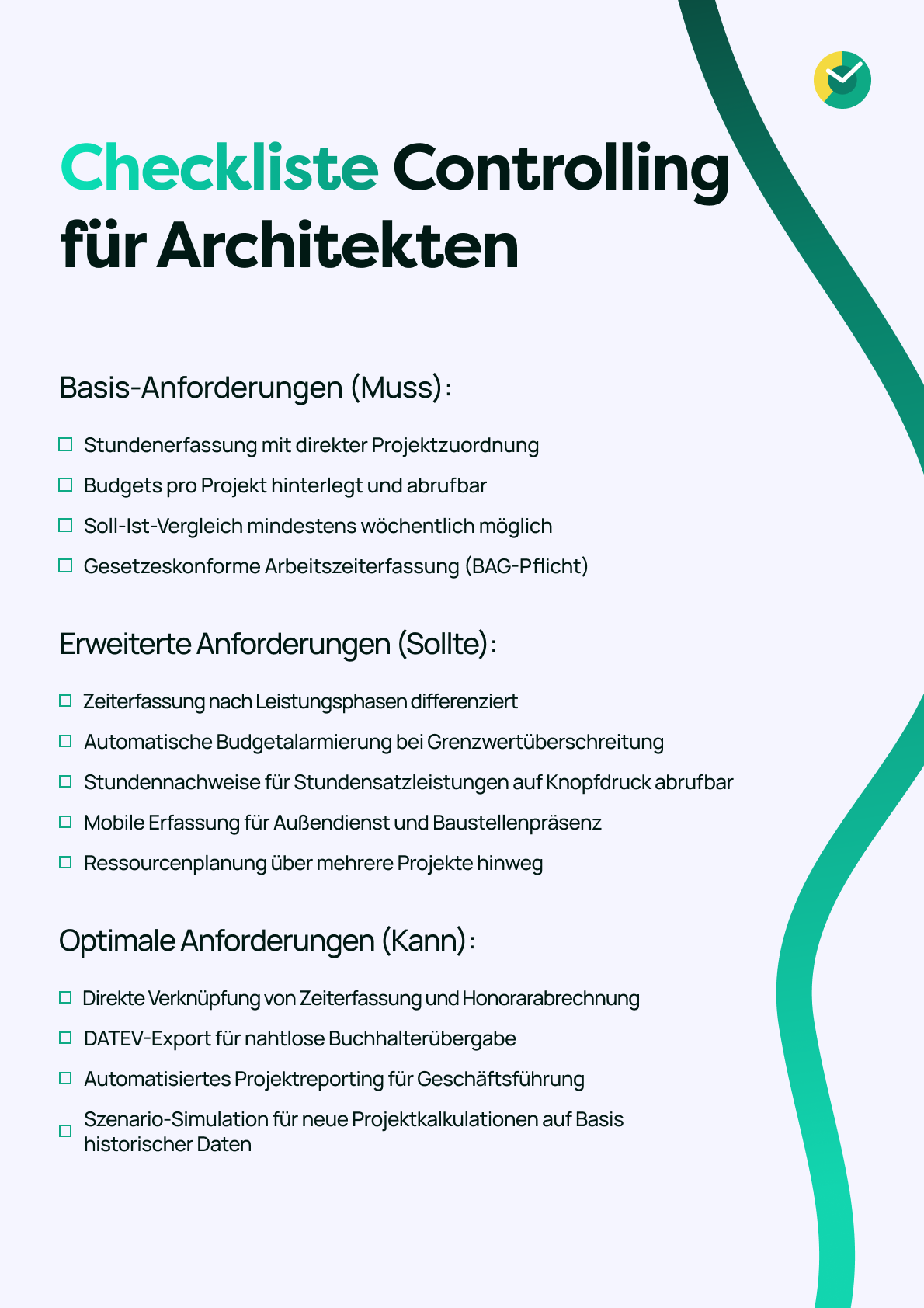
Firms that try to meet all the basic requirements without a digital system quickly reach their capacity limits. The advanced and optimal requirements are practically impossible to achieve manually.
How systematic time recording protects margins
Project controlling in architecture firms follows a different logic than in manufacturing: no product is made; planning services are delivered, and their value depends directly on the documented time. This makes time recording the basis not only of billing, but of the entire commercial management system.
What ZEP does in practice
ZEP is web-based software for project time tracking and project controlling, developed specifically for project-based service companies, including architecture and engineering firms. It solves the three central problems described above:
The budget transparency problem is solved by automatic plan-vs-actual comparisons: every booked hour is counted against the project budget, so the plan-vs-actual status is always up to date. Project managers see in real time which projects are on track and where action is needed.
The reporting problem is addressed by a shared data basis: all relevant KPIs (booked hours, budget status, utilization, plan-vs-actual variance) come from the same bookings and are always up to date. Instead of merging data manually over several hours, the basis for a reliable report is in place within a few minutes.
The documentation problem for field work is solved by the mobile app: employees book their hours directly on site, the data is synchronised in encrypted form and stored in an audit-proof way. This also meets the statutory obligation to record working time following the 2022 BAG decision.
Before and after in everyday office life
Before: four hours of reporting effort per week, Excel spreadsheets with manual transfer errors, budget overruns detected too late, paper-based timesheets for work stage 8.
After: 15 minutes of reporting effort, automatic plan-vs-actual comparisons in real time, budget status visible at all times, mobile booking of hours on site and in the field, audit-proof documentation for all requirements.
Budget planning also benefits: historical project data from the system provides a reliable basis for new calculations. Firms that know how many hours a work stage actually took on comparable projects calculate more precisely and protect their margin from the start.
Conclusion
Project controlling for architects is not an accounting task to be done at the end of the month. It is an ongoing management instrument that has to work in everyday project life: close to the construction site, close to the project manager, close to the work actually delivered. If you apply this approach consistently, you not only protect margins, you also build the data basis needed for more precise calculations, faster decisions and legally sound documentation. The tools for this exist. The question is when the manual effort becomes more expensive than the solution.
FAQs
How can an architecture firm keep track of project costs and hour budgets across several parallel projects?
The decisive step is to link time recording and project budgets in a single system. Every recorded hour is then automatically assigned to the relevant project and work stage and compared against the calculated budget. A traffic-light indicator or automatic alert signals as soon as a defined threshold is reached. Separate Excel spreadsheets for hours and budgets do not work in practice, because manual synchronisation takes too much time and is error-prone.
Which KPIs really matter for project controlling in an architecture firm?
The three most important metrics are budget consumption per work stage relative to plan, the billability rate (the share of hours worked that is actually billable) and the project margin, meaning the ratio of fees earned to resources actually used. Resource utilization at employee level also helps you spot bottlenecks and idle time early.
What does missing or unstructured time recording actually cost an architecture firm?
Direct costs come from unbilled additional services that are lost for lack of documentation, from invoice reductions on hourly-rate items without reliable proof, and from the administrative effort of manual reporting and data consolidation. There is also the risk of fines of up to €30,000 if the record-keeping duties of the German Working Hours Act (ArbZG) are violated; the general obligation to record working time follows from the 2022 decision of the German Federal Labour Court (BAG). Indirect damage arises when future projects are miscalculated because historical consumption data is not available systematically.
How can project controlling be structured around the HOAI work stages?
The HOAI, the German fee structure for architects and engineers (Honorarordnung für Architekten und Ingenieure), divides planning services into nine work stages with different fee shares. For controlling to work, budgets should be calculated per stage and time recording structured accordingly. That way you can see at any time whether the budget for a particular stage is still sufficient or whether you need to take corrective action early. Additional services outside the commissioned scope are recorded as separate items and can be billed as change orders.
At what firm size does dedicated project controlling software for architects pay off?
From as few as five to seven employees and three or more parallel projects, the manual effort of Excel-based controlling becomes disproportionately high. At this size, the time spent on manual reporting and data reconciliation typically exceeds the licence cost of software. What matters is not the headcount, but the number of simultaneously active projects and the need to manage resources across projects.
How are time recording and fee billing under the HOAI connected?
For services billed at hourly rates (for example certain special services or site supervision billed by effort), a complete, traceable timesheet is the prerequisite for a reliable invoice. Clients can challenge hourly-rate invoices without documentation. At the same time, complete time recording by work stage provides a reliable basis for adjusting fees if the eligible costs change significantly during the project. Systems that connect time recording and billing directly help establish this link automatically.
Good to know: In ZEP Operations, an HOAI fee calculator is part of Proposals. The fee is calculated according to the HOAI in the proposal itself, and the booked project hours then show the actual effort per work stage.