

Time tracking when working from home is not a grey area in Germany. It is mandatory, and has been since the ruling of the Federal Labour Court (Bundesarbeitsgericht, BAG) in September 2022. Even so, practice at many professional services firms looks different: employees working remotely book their hours irregularly, project leads lose track and, when the quarter ends, hours are missing from the records or the billing.
In 2026, there is another factor: the 2025 coalition agreement between the CDU/CSU and SPD has cleared the way for a statutory obligation to record working time electronically. What has so far been derived from the BAG ruling and the Occupational Safety and Health Act (Arbeitsschutzgesetz, ArbSchG) is to be turned into a specific law. Companies still relying on manual processes or Excel are therefore taking an operational risk and are on uncertain legal ground.
What this means in concrete terms for professional services firms:
- The obligation to record working time applies regardless of where people work, including from home and on business trips
- Electronic recording is becoming the statutory standard
- Violations of the Working Hours Act can be penalized by the authorities
- Incomplete time data puts project billing and margin transparency at risk
Why time tracking when working from home is a business issue for professional services firms
According to the Federal Statistical Office (Destatis), around 25 percent of all employed people in Germany worked from home at least occasionally in 2025. In IT services, this share was 76.4 percent according to the ifo Institute in February 2026, and 67.6 percent in management consulting. These are exactly the industries in which time tracking feeds directly into project billing, margin and forecast.
The operational problem is not a lack of willingness among employees. It is the infrastructure. If you do not provide a reliable recording solution that works on mobile devices, you get hours after the fact, incomplete or as estimates, and you base your calculations on them.
Where time data gets lost in a remote setup
In practice, gaps appear in three places:
- Booking delays. Employees working from home enter their hours retroactively more often, frequently only on Friday afternoon or at month-end. What you get then is not time data, but reconstructions.
- Missing project assignment. Working time is booked, but without a clear project assignment. The result: the hours exist, but cannot be analyzed for controlling or billing.
- Unrecorded overtime. At home, work and free time blur. If you answer emails in the evening or finish a deliverable at the weekend, you often do so without booking the time. For the company, this creates invisible effort that flows neither into the project margin nor into resource planning.
For professional services firms with billable hours, this is not an HR problem. It is a revenue problem.
The legal basis in Germany in 2026: what applies and what is coming
Existing obligations: ArbZG and the BAG ruling
The Working Hours Act (Arbeitszeitgesetz, ArbZG) sets out what applies to all employees, regardless of where they work:
- A maximum of eight hours of working time per day, extendable to ten hours if offset within six months
- At least eleven hours of uninterrupted rest between two working days
- A break of at least 30 minutes for more than six hours of work, 45 minutes from nine hours
The BAG ruling of 13 September 2022 makes it clear: the obligation to record working time systematically already applies today, even without a specific implementing law. The system must be objective, reliable and accessible. Blanket trust-based working time without documentation does not meet these requirements.
Planned reform: an electronic recording obligation is in preparation
The 2025 coalition agreement has set the direction. The planned time recording law is to make electronic systems the standard, define clear retention periods and turn the current legal situation based on the BAG ruling into codified law.
Which transition periods apply will only be clear once a law has been passed. If you do not yet run a legally compliant system, you should not postpone the switch until the statutory deadline.
Important: the obligation lies with the employer. Employers can delegate the actual recording to employees, but responsibility for completeness and accuracy remains with the company. Incorrect or incomplete records are legally the organization's risk, not the individual's.
Breaks and rest periods: a particular challenge when working from home
Statutory break rules are hard to monitor when people work from home. Employees skip their lunch break, start earlier or keep working late in the evening. That is exactly why automatic break checks in the time tracking solution are not a convenience feature, but a compliance requirement.
Putting it into practice at professional services firms: where Excel fails
Many professional services firms still work with Excel lists or hybrid solutions made of spreadsheets, forms and manual additions. What works in the office breaks down structurally in a remote setup.
The real cost of manual recording
Take an engineering firm with 30 employees, 20 of them working from home or hybrid. If five people each book two hours per week late or incompletely, 40 hours of data are missing for project billing at month-end. At an hourly rate of €100, that is €4,000 of potential billing loss per month, and that is a conservative scenario.
On top of that comes the correction effort: someone in the operations team has to validate the data, follow up and consolidate it. That ties up time that does not show up as overhead in any project margin.
Why project time tracking when working from home needs its own logic
Working time tracking and project time tracking are not the same. Booking eight hours does not answer which project, task or client those hours belong to. For professional services firms, this assignment is exactly the decisive data point: it determines billability, project margin and resource utilization.
A good solution lets employees book hours directly to projects, subprojects and tasks, in real time, from a smartphone, browser or desktop. On this basis, managers can see how capacity is tied up and where bottlenecks are forming before they become a problem.
Trust-based working time and the obligation to record: no contradiction
Trust-based working time means that employees organize their working hours on their own responsibility. It does not mean that there is no documentation. The BAG ruling explicitly rules out trust-based working time without records. If you want to keep offering this model, you need a system that documents actual hours without destroying the character of flexible self-organization.
{{blog-cta}}
Setting up ZEP for remote teams: how it works in practice
ZEP is designed for both central and distributed project teams. Setting it up for a remote setup follows a clear logic.
Step 1: create employees and projects
In ZEP, all employees are stored with their target working hours, locations and project assignments. Absences, working time models and roles are managed centrally. This creates the data foundation that compliance records and project controlling both need.
Step 2: activate project time tracking and define the booking logic
In ZEP, hours are booked to projects and tasks, not just as attendance data. For each project, you can store billable hours, internal hours and budgets. The result: every hour booked from home is immediately assigned to a commercial category.
Step 3: set up the mobile app and browser booking
Employees can book their hours via the ZEP app on their smartphone, in the browser or via the desktop application. For hybrid teams that switch between the office, home and client appointments, this is the only solution that avoids media breaks. Bookings are made in real time or can be added on the same day.
Step 4: automatic break checks and compliance checks
ZEP automatically checks whether statutory breaks and rest periods have been observed. Managers are notified of deviations without any manual comparison. This takes the load off operations and HR and creates a traceable compliance record for authorities or works councils.
Step 5: reports and planned vs. actual comparison
Based on the booked hours, ZEP provides reports on project utilization, budget deviations and individual working time. Project leads see where a project stands. From ZEP Operations, finance can move billable hours straight into Invoicing. COOs and operations leads get the data foundation for reliable forecasts.
ZEP connects working time tracking, project time tracking and project controlling on one data foundation. This makes remote work manageable instead of a control problem.
Resource planning and forecasting: what is missing without clean data from home
Professional services firms manage their business through three core figures: utilization, margin and forecast. All three depend directly on the quality of time data. If a quarter or more of employees work remotely and the time bookings from this group are incomplete, a structural part of the management basis is missing.
Utilization without remote data is not reliable
A utilization overview that only reflects office presence gives a distorted picture. Employees working from home appear underutilized if their booked hours are missing. Resource decisions made on this basis distribute work wrongly: the remote employees who are actually fully loaded get more tasks, while the supposedly free office staff are spared.
At professional services firms with 30 or more employees and a hybrid setup, this effect can lead to systematic planning errors over months, which only become visible when projects have to deliver.
Project margin needs complete hour data
The project margin results from billed hours minus internal effort. If remote employees book hours late, incompletely or without project assignment, both sides of this equation are incomplete. Billable hours are understated, internal effort stays invisible.
The result is a systematic underestimation of the real project costs. Projects look more profitable in controlling than they are. Follow-up projects are calculated on this distorted data.
Forecasting needs real-time data
A reliable forecast requires current capacity and utilization to be known. In a remote setup where bookings arrive late, forecasting always works against an information backlog. Decisions about new projects, hiring or discounts are made on outdated data.
For COOs and operations leads at professional services firms, this is a structural problem. More frequent meetings will not solve it. An infrastructure that delivers real-time data is the only reliable solution, regardless of whether the person is in the office, at home or at the client's site.
ZEP connects project time tracking, Resource Planning and project controlling on one data foundation. This makes remote teams manageable, not just documentable.
When a system becomes an economic necessity
Most professional services firms that do not yet have structured time tracking for people working from home know the problem. It does not escalate immediately; it accumulates.
Month after month, hours are missing from billing. Resource planning is based on estimates instead of data. Project leads cannot explain to management why a project is over budget, because the time data is missing. And HR spends too much time validating time records that are still incomplete in the end.
The question is not whether a structured system is necessary. The question is when the damage caused by not having one becomes greater than the effort of introducing it.
Concrete triggers at which professional services firms need to act:
- More than 30 percent of the team works remotely or hybrid
- Time bookings regularly arrive late or incomplete
- Monthly billing takes more than two working days
- Project margins cannot be reported reliably
- A works council or an authority requests records
If you need to integrate freelancers and external resources, you reach this point even sooner, because external time bookings cannot be brought together structurally without a central platform.
Conclusion
Do not file time tracking for people working from home away as an HR topic. It is a management topic. Incomplete time data from the remote setup costs billing volume, worsens margin transparency and endangers compliance before anyone notices.
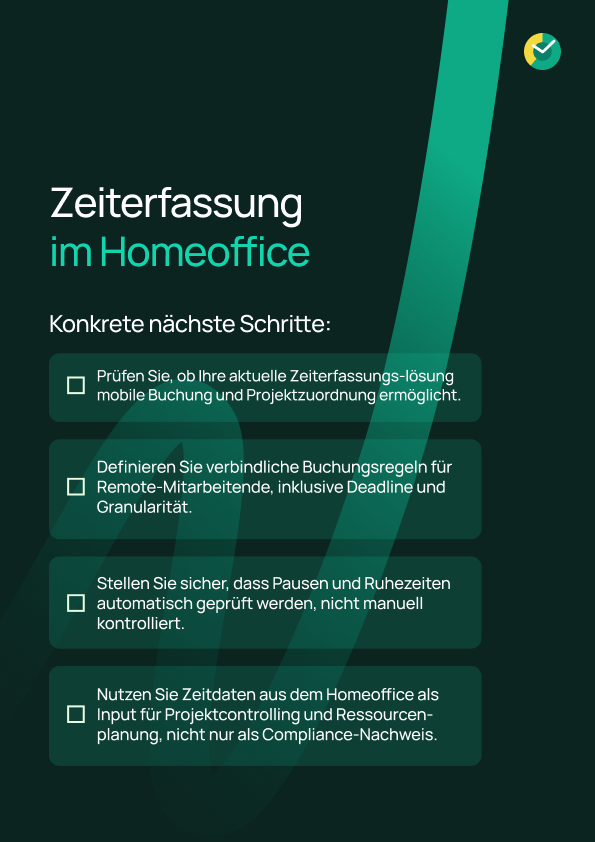
ZEP brings these four requirements together on one platform, for professional services firms that want to scale without losing operational control.
FAQs
Does the obligation to record working time also apply to employees working from home in Germany?
Yes, the obligation to record working time applies to all employees in Germany, regardless of where they work. The obligation follows from the Federal Labour Court (BAG) decision of 13 September 2022 (1 ABR 22/21) and therefore also covers working from home, field work and business trips. A time recording law has not yet been passed. Employers must provide an objective, reliable and accessible system.
What will the 2026 working time reform change for remote teams?
The 2025 coalition agreement provides for a statutory obligation to record working time electronically. No such law has been passed yet. Companies still using manual systems should plan the switch to electronic recording early. The obligation lies with the employer: incorrect or incomplete records are the employer’s legal risk, even if the recording is delegated to employees.
Can I offer trust-based working time for people working from home without recording hours?
No. Trust-based working time governs how employees organize their own time, not whether documentation exists. The German Federal Labour Court (BAG) ruling rules out trust-based working time without records. Companies that want to keep this model need a solution that documents actual working hours without restricting flexibility.
How should a professional services firm organize project time tracking for people working from home?
Employees should book their hours directly to projects, subprojects and tasks, not just as attendance time. A mobile solution that allows real-time booking is essential. Binding booking rules with a deadline reduce delays and secure data quality for billing and controlling.
Which data from time tracking at home do I need for project controlling?
For reliable project controlling, you need time bookings with project assignment, billability and task reference. With these, you can calculate planned vs. actual deviations at project level, pass billable hours on to invoicing and use resource utilization for planning. Pure attendance data is not enough for this.
What does missing or manual time tracking for people working from home cost?
The direct costs come from billing losses when hours are not booked on time or without project assignment. On top of that come indirect costs from operations effort for data validation and corrections, and from a lack of margin transparency that encourages wrong decisions in project planning. At professional services firms with a high share of remote work, this effect can quickly reach four figures per month.